

- Katılım
- 4 Şub 2022
- Mesajlar
- 14,258
- Beğeni
- 12,783
Cassius Dio relates an anecdote that, prior to the wedding of Septimius Severus and Julia Domna, Septimius is supposed to have dreamt that Faustina Senior, wife to the last worthy emperor Marcus Aurelius, prepared their nuptial chamber within the Temple of Venus and Roma, near the imperial palace. Such a link back to the golden years before the depravations of Commodus and the ensuing civil war implied to the ever-superstitious plebs Faustina's approval of Septimius and Julia, offering her blessing to them while portending their destiny as the rightful rulers of the empire, sent to guide Rome back to better times.
Septimius aspired to restore peace and stability to the Roman Empire, and his wife Julia was to play an instrumental role in this endeavour. By all accounts their marriage was a very happy one, and it is testament to the affection in which Julia held her husband that she chose to accompany Septimius on all of his military campaigns at a time when the women of Rome were expected to stay behind in the city and await their husband's return. Fittingly, the high regard in which Septimius held his wife for her resilience, political views and faithfulness is attested to by the great number of titles conferred upon her, including that of Mater Senatus et Patriae [mother of the Senate and Rome] and, on account of her companionship in the field, Mater Castrorum [mother of the camp].
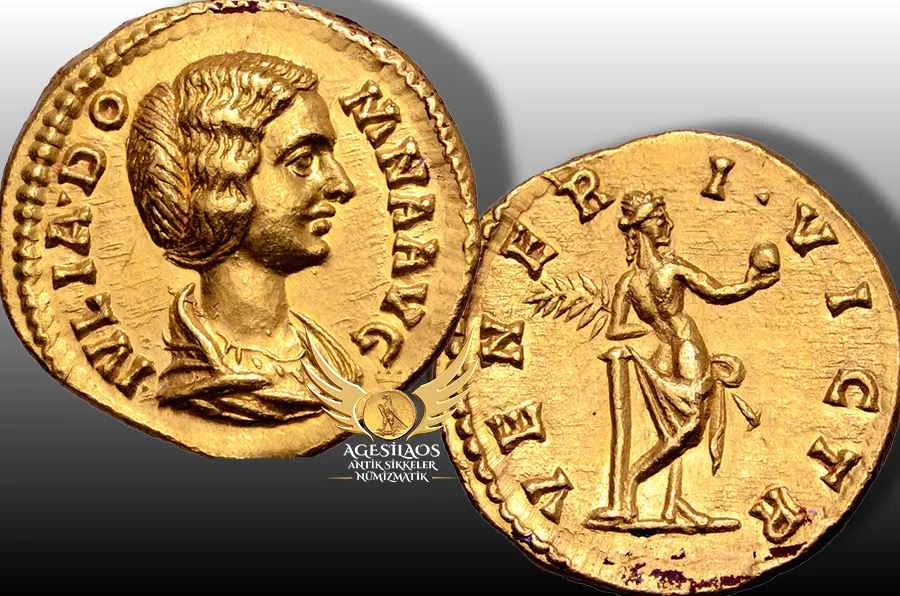
The naturally strong bond exhibited by Septimius and Julia could not have been a better stabiliser to the teetering empire after the so-called Year of the Five Emperors' in AD 193, and the opportunity was not lost on the new emperor and empress to secure their own positions. An association with Venus was favoured for the Empress' early coinage, so that the first issues struck for Julia feature the goddess, as we see on this stunning aureus. Julia was to be presented as a model of traditional Roman values, and here we see why the association with Venus was a crucial starting point: Venus is represented as the goddess of victory, holding a globe in her hand to signify Roman dominion over the known world. Of course, her other roles as goddess of love, beauty, fertility and motherhood, all equally important to Julia, are not forgotten in the design of this reverse type and further secure her position as the mother of the state.
Septimius aspired to restore peace and stability to the Roman Empire, and his wife Julia was to play an instrumental role in this endeavour. By all accounts their marriage was a very happy one, and it is testament to the affection in which Julia held her husband that she chose to accompany Septimius on all of his military campaigns at a time when the women of Rome were expected to stay behind in the city and await their husband's return. Fittingly, the high regard in which Septimius held his wife for her resilience, political views and faithfulness is attested to by the great number of titles conferred upon her, including that of Mater Senatus et Patriae [mother of the Senate and Rome] and, on account of her companionship in the field, Mater Castrorum [mother of the camp].
The naturally strong bond exhibited by Septimius and Julia could not have been a better stabiliser to the teetering empire after the so-called Year of the Five Emperors' in AD 193, and the opportunity was not lost on the new emperor and empress to secure their own positions. An association with Venus was favoured for the Empress' early coinage, so that the first issues struck for Julia feature the goddess, as we see on this stunning aureus. Julia was to be presented as a model of traditional Roman values, and here we see why the association with Venus was a crucial starting point: Venus is represented as the goddess of victory, holding a globe in her hand to signify Roman dominion over the known world. Of course, her other roles as goddess of love, beauty, fertility and motherhood, all equally important to Julia, are not forgotten in the design of this reverse type and further secure her position as the mother of the state.