

- Katılım
- 4 Şub 2022
- Mesajlar
- 14,396
- Beğeni
- 12,788
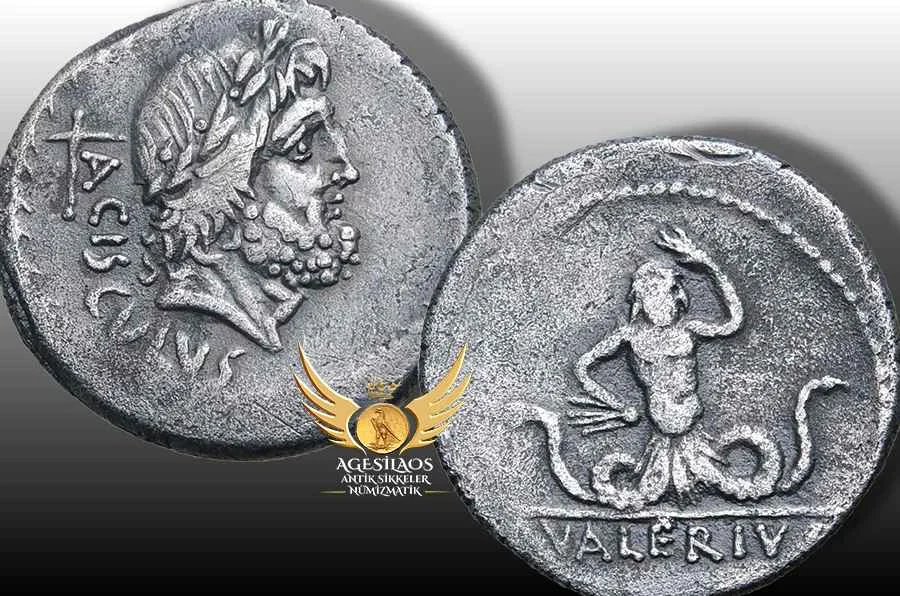
This extremely rare denarius highlights a climactic moment in the myth of the Gigantomachy, the cataclysmic battle between the Olympian gods and the earth-born Giants that took place when the former established themselves as the new rulers of the cosmos. The giants, who were depicted in iconographic tradition inherited from the Ancient Greeks as anguipedic - with serpents for legs as a sign of their origin as sons of Gaia - were led by their king Porphyrion, who is likely depicted on the reverse.
According to the Roman version of the myth, Porphyrion attacked Hercules and Juno and was on the point of destroying them when Jupiter inspired a desire for Juno in the giant, and struck him down with a thunderbolt while Hercules shot him with an arrow. This dynamic reverse image shows the blazing thunderbolt striking the giant's side as he weakly raises a hand to his face to protect himself from Hercules' arrow, his serpent legs flailing in pain. The obverse identifies his slayer as Jupiter, the king of the Olympian gods, with a stern and commanding portrait with a full curled beard and long hair crowned with a laurel wreath.
Both the obverse legend and the accompanying pick-axe [acisculus] symbol identify the moneyer Lucius Valerius Acisculus, in a punning reference to his cognomen. That this type is so extremely rare may not be surprising: Sear suggests that it may have been interpreted [perhaps rightly] as an allegory for Julius Caesar's intention to overthrow the old order in which the Senate was supreme and establish himself as a Jupiter on earth to rule the Roman empire as king [The History and Coinage of the Roman Imperators, p.56].
Caesar had already cemented his position as dictator, having decisively defeated Pompey and his other opponents in a series of bloody battles a few years earlier; it is well known that Caesar's apparent inclinations towards kingship and divinity pushed the senatorial liberatores to assassinate him on the Ides of March of 44 BC, and Sear hints that these coin types, which seem to have been abruptly terminated, may have been a contributing factor. Desnier, on the other hand, gives a more backward-looking interpretation, seeing the type as simply the expression of the defeat of dark forces after several years of brutal civic strife. He notes that coins of Acisculus feature the figure of Victory with double cornucopiae, suggesting that this moneyer's issues simply celebrate peace after cataclysmic warfare, without any pretension on Caesar's part to future kingship or deification. Whichever interpretation seems more likely, this coin remains a superior example of one of the rarest of all Republican denarii, minted during [and perhaps contributing towards] a turbulent and pivotal moment for the Roman Republic.
According to the Roman version of the myth, Porphyrion attacked Hercules and Juno and was on the point of destroying them when Jupiter inspired a desire for Juno in the giant, and struck him down with a thunderbolt while Hercules shot him with an arrow. This dynamic reverse image shows the blazing thunderbolt striking the giant's side as he weakly raises a hand to his face to protect himself from Hercules' arrow, his serpent legs flailing in pain. The obverse identifies his slayer as Jupiter, the king of the Olympian gods, with a stern and commanding portrait with a full curled beard and long hair crowned with a laurel wreath.
Both the obverse legend and the accompanying pick-axe [acisculus] symbol identify the moneyer Lucius Valerius Acisculus, in a punning reference to his cognomen. That this type is so extremely rare may not be surprising: Sear suggests that it may have been interpreted [perhaps rightly] as an allegory for Julius Caesar's intention to overthrow the old order in which the Senate was supreme and establish himself as a Jupiter on earth to rule the Roman empire as king [The History and Coinage of the Roman Imperators, p.56].
Caesar had already cemented his position as dictator, having decisively defeated Pompey and his other opponents in a series of bloody battles a few years earlier; it is well known that Caesar's apparent inclinations towards kingship and divinity pushed the senatorial liberatores to assassinate him on the Ides of March of 44 BC, and Sear hints that these coin types, which seem to have been abruptly terminated, may have been a contributing factor. Desnier, on the other hand, gives a more backward-looking interpretation, seeing the type as simply the expression of the defeat of dark forces after several years of brutal civic strife. He notes that coins of Acisculus feature the figure of Victory with double cornucopiae, suggesting that this moneyer's issues simply celebrate peace after cataclysmic warfare, without any pretension on Caesar's part to future kingship or deification. Whichever interpretation seems more likely, this coin remains a superior example of one of the rarest of all Republican denarii, minted during [and perhaps contributing towards] a turbulent and pivotal moment for the Roman Republic.