

- Katılım
- 4 Şub 2022
- Mesajlar
- 14,396
- Beğeni
- 12,788
Quintus Labienus was a Roman nobleman whose father, Titus, was killed by Caesar in the Battle of Munda in 45 BC. After the assassination of the dictator at the Ides of March 44, the younger Labienus joined the cause of Cassius and Brutus, who sent him as an envoy to the Parthian King Orodes II [57-38 BC] to seek the King's aid against the Caesarians. Having arrived in Ktesiphon, Labienus learned about the disastrous loss of the Republicans in the Battle of Philippi and the subsequent proscriptions of political opponents by the triumvirs. With no place to go, he decided to side with the Parthians and to persuade Orodes to attack the Roman Empire. In early 40 BC, a large Parthian army under the joint command of the prince Pakoros and Labienus invaded Syria, where it was reinforced by veterans of the legions of Cassius and Brutus.
It is during this time that our coin was struck, most likely as part of the payments of Labienus to his troops. The types are truly remarkable, for the obverse calls Labienus Parthicus, whereas the reverse shows a horse with a quiver and thus clearly refers to the help he was receiving from the very Parthian cavalry that had annihilated Crassus' army at Carrhae thirteen years before. The massive threat that Labienus and his Parthian allies posed to Mark Antony and Octavian forced the latter to reconcile in October 40 and to send out an army under the command of Publius Ventidius Bassus to repel the invasion.
Publius Ventidius Bassus proved to be an able commander, for Labienus and his Parthian allies were decisively defeated in several battles in 39-38 BC and the Roman rule over the East was eventually restored. Labienus himself was captured in Cilicia by a freedman of Caesar named Demetrios and put to death as a traitor. As the last of the Liberators to continue the fight against the Caesarians, Labienus has always been one of the most interesting and controversial figures in Roman history. Many have characterized him as an unscrupulous traitor to his people, while others praised him as the last defender of the res publica against the tyranny of the Caesarians. The truth probably lies somewhere in the middle: the defeat of Cassius and Brutus at Philippi left Labienus few options, but the sight of a Roman nobleman leading a Parthian invasion into the empire certainly throws a dark shadow on his legacy.
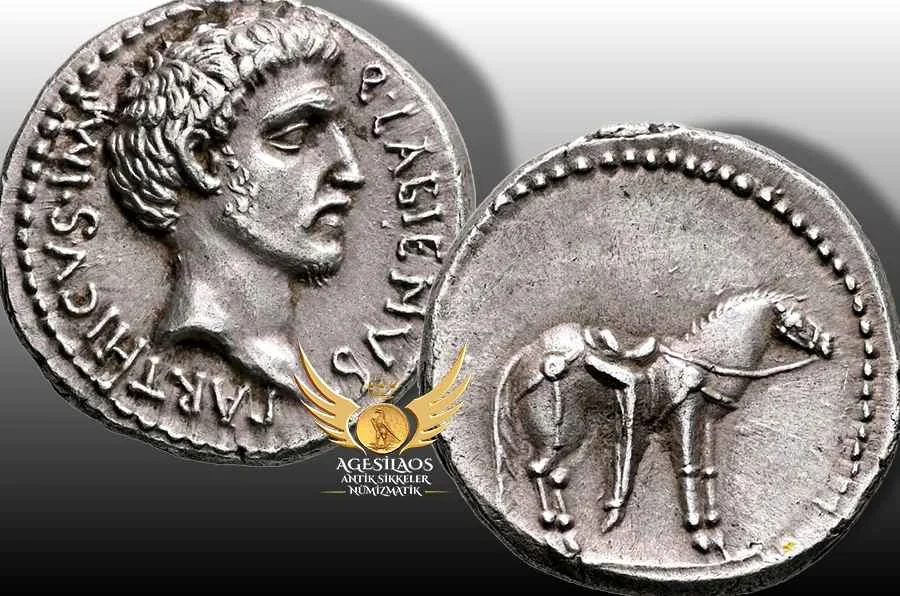
It is during this time that our coin was struck, most likely as part of the payments of Labienus to his troops. The types are truly remarkable, for the obverse calls Labienus Parthicus, whereas the reverse shows a horse with a quiver and thus clearly refers to the help he was receiving from the very Parthian cavalry that had annihilated Crassus' army at Carrhae thirteen years before. The massive threat that Labienus and his Parthian allies posed to Mark Antony and Octavian forced the latter to reconcile in October 40 and to send out an army under the command of Publius Ventidius Bassus to repel the invasion.
Publius Ventidius Bassus proved to be an able commander, for Labienus and his Parthian allies were decisively defeated in several battles in 39-38 BC and the Roman rule over the East was eventually restored. Labienus himself was captured in Cilicia by a freedman of Caesar named Demetrios and put to death as a traitor. As the last of the Liberators to continue the fight against the Caesarians, Labienus has always been one of the most interesting and controversial figures in Roman history. Many have characterized him as an unscrupulous traitor to his people, while others praised him as the last defender of the res publica against the tyranny of the Caesarians. The truth probably lies somewhere in the middle: the defeat of Cassius and Brutus at Philippi left Labienus few options, but the sight of a Roman nobleman leading a Parthian invasion into the empire certainly throws a dark shadow on his legacy.